

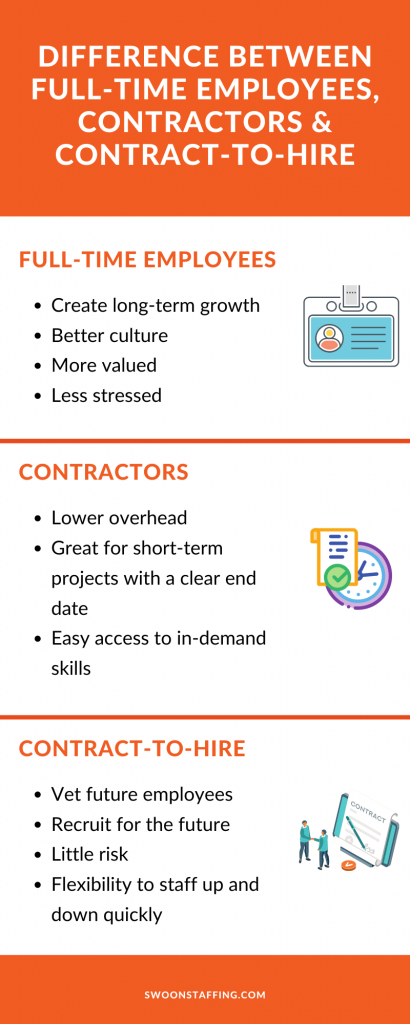
Choosing between contract and full-time work is a big decision, and both paths offer unique advantages. Whether you’re drawn to the flexibility that contract roles offer or the stability of a full-time position, the right choice just depends on your goals, work style, and priorities.
Weighing your options? Let’s dive into some of the differences!
Flexible or Stability—What’s Your Ideal Work Style?
Contract Work: Love the idea of choosing your projects, setting your own schedule in some circumstances, and working across different industries? Contracting offers the freedom to explore, learn, and grow without being tied to a single employer. You can take breaks between assignments, work on short-term passion projects, and expand your skill set in ways that full-time roles may not allow.
Full-Time Work: If long-term security, structured career progression, and being deeply involved in a company’s mission sound more appealing, full-time work might be the way to go. You’ll have a consistent salary, benefits, and opportunities to climb the corporate ladder within one organization.
Career Growth—Diversify or Climb the Ladder?
Contract Work: If you want variety and to gain experience across multiple industries, companies, and projects, contract work is a great way to build a diverse skill set. It’s perfect for those who love continuous learning and adapting to new challenges.
Full-Time Work: Full-time employees benefit from structured career growth within an organization, with leadership opportunities, mentorship programs, and long-term professional development.
Work-Life Balance—More Control or More Predictability
Contract Work: Contractors can take breaks between projects, work remotely in some cases, and choose roles that align with their priorities. If you want control over when and where you work, contract roles can sometimes offer this freedom.
Full-Time Work: Full-time roles provide a structured routine and predictable hours, which can be great for those who prefer consistency in their work-life balance. Plus, full-time employees typically receive paid time off, holidays, and other employer-sponsored benefits, making it easier to take time off without worrying about gaps in income.
Job Security—What Matters Most?
Contract Work: While some worry about gaps between projects, experienced contractors often build strong networks and relationships that keep opportunities flowing. Contracting can offer a different type of stability—by creating multiple career paths and options.
Full-Time Work: Full-time employees enjoy long-term stability within a single company, with the reassurance of a steady paycheck and employer benefits.
How Swoon Can Help—No Matter Your Path
Whether you’re leaning toward contract or full-time work, partnering with the right staffing agency can make all the difference.
Contract Work: Swoon connects contractors with top companies looking for specialized talent, ensuring a steady flow of opportunities. Plus, contractors can enjoy benefits like health insurance, 401(k), and dedicated support throughout their contracts.
Full-Time Work: Looking for a role that aligns with your career goals? Swoon works directly with hiring managers to match professionals with full-time positions that fit their skills, experience, and career goals.
Both: The best part? We advocate and network for you! Whether you’re looking for your next project or a long-term role, we leverage our industry connections to help you land the right opportunity—without the stress of job searching alone.
So, Which Path is Right for You?
The beauty of the job market is that you don’t have to be locked into one path forever. You can explore contract work for a few years, transition into a full-time role, or even do both throughout your career.
Both options come with exciting benefits—so the choice is the one that fits where you are right now in your professional journey. Ready to make your next move? Let’s chat!
When looking to attract and retain top talent, the candidate experience is everything. It’s not just about the salary or the benefits–top talent is also looking for a seamless and engaging onboarding experience. Let’s dive into why the candidate experience matters and how you can elevate it in a way that keeps top candidates excited and engaged throughout the process.
First Impressions Matter
The first step in the hiring process–how candidates encounter your job postings and apply–sets the tone for the entire candidate experience.
What to do:
- Write clear, engaging job descriptions that reflect your company culture.
- Avoid lengthy applications that make candidates feel like they’re jumping through hoops.
AI in Action:
- AI-powered tools like chatbots can guide candidates through the application process, answering their questions in real-time and providing instant support 24/7, which can help streamline the process and make it feel more personal.
- Resume screening software can scan applications, ranking candidates based on specific keywords, skills, or experience, allowing your team to focus only on the top candidates. Just remember that AI is not flawless and should be reviewed consistently to make sure you’re not missing out on strong talent just because they don’t fit the traditional mold.
Communication is Key
Ghosting candidates or leaving them in the dark can damage your employer brand and steer candidates away.
What to do:
- Send personalized emails to acknowledge receipt of applications and provide updates on next steps in your process.
- If a candidate is rejected, offer constructive feedback where possible–this helps turn a negative experience into a more positive one.
AI in Action:
- Having an AI-driven system in place can help automate updates and provide candidates with timely information on their application status, interview schedules, and any delays. This will help keep your candidates in the loop without bogging down your team members.
Make Your Interviews Personal and Meaningful
The interview should be a conversation–not an interrogation. Candidates want to connect, learn about your company, and showcase their strengths beyond their resume.
What to do:
- Ask open-ended, situational questions to understand how candidates approach challenges.
- Allow time for candidates to also ask you questions. It is a two-way street, after all.
- Be transparent about the role, culture, and what success looks like so candidates can make more informed decisions.
AI in Action:
- Use AI interviewing tools like HireVue or Pymetrics to complete initial video interviews. These tools can assess facial expressions, tone of voice, and word choice while freeing up time for your team members.
Let Candidates Know Where They Stand
One of the biggest frustrations for job seekers is ghosting. This lack of communication not only leaves candidates wondering where they stand but can also hurt your candidate experience.
What to do:
- Be transparent about your timeline and process.
- Provide feedback to candidates you aren’t moving forward with.
- Ensure timely follow-ups to show respect for their time and effort throughout the process.
AI in Action:
- Use AI-powered survey tools to automate post-interview feedback requests. This will help you get feedback and reevaluate your current process as needed.
A Seamless Onboarding Experience
Onboarding is more than just paperwork–it’s the final chapter of the candidate experience. A positive onboarding process can turn new hires into long-term, engaged employees.
What to do:
- Start engaging new hires before their first day–send them materials about the company culture, team they’ll be working on, and job expectations.
- Make sure the first day is organized and welcoming. Ensure their workspace is ready, set up meetings with key team members, and give them a quick tour of the office space.
- Provide a structured but fun onboarding program that helps new hires feel supported.
AI in Action:
- Use AI onboarding platforms to automate the sending of necessary documents, schedule their training sessions, and even personalize their onboarding experience.
Gather Feedback and Continuously Enhance
Building a strong candidate experience is an ongoing effort. By gathering feedback from candidates, you can continuously tweak and improve your process.
What to do:
- Send post-interview or onboarding surveys to gather insights on how candidates felt about their experience.
- Make sure the feedback loop is open, allowing for suggestions from both candidates and your hiring team.
AI in Action:
- Use AI-powered analytics to measure and track candidate satisfaction at every stage.
A great candidate experience isn’t just about getting the right person hired–it’s also about building your employer brand and ensuring that even those who don’t get the job will walk away feeling valued.
The workforce has started entering a period of change. According to a recent survey by Staffing Industry Analysts, over half of employees are open to exploring new job opportunities in 2025. While this trend, dubbed the “2025 Talent Exodus,” may sound like a challenge, it’s also a unique opportunity for organizations to refine their strategies, strengthen their teams, and position themselves as employers of choice.
Here are a few ways you can embrace the shift, retain top talent, and thrive in this job market.
Reassess Your Employee Value Proposition
What sets your company apart? Employees today prioritize more than just a paycheck–they’re seeking purpose, growth, and balance. Top priorities for job seekers include competitive pay, career advancement, work-life balance, and a strong company culture.
Evaluate your workplace culture, benefits, and growth pathways. Are you offering things that your employees actually value? To find out, ask your team by conducting surveys or focus groups to pinpoint areas for improvement.
Double Down on Employee Engagement
Engaged employees are less likely to seek opportunities elsewhere. Foster a culture where employees feel valued and heard. Regular check-ins, team-building activities, and recognition programs go a long way in boosting morale.
Implement “stay interviews” to understand what keeps employees happy and motivated. Proactively addressing their needs can prevent turnover before it starts. For example, you might learn that employees value mentorship opportunities or flexible scheduling. Act on this feedback to increase engagement.
Build Clear Career Paths
Most employees want growth, and if they can’t find it with you, they’ll look elsewhere. Ensure each role within your organization has a defined path for advancement—partner with your team members to identify their career aspirations and provide resources to help them get there.
For example, introducing leadership development programs or job rotation opportunities can show that you’re invested in their future. A quarterly career development meeting can also provide employees with a forum to discuss their goals and receive advice on achieving them. Make sure these career paths are transparent and flexible. Employees are more likely to stay if they see a clear trajectory that aligns with their ambitions.
Strengthen Your Employer Brand
In a competitive job market, your employer brand is essential. Highlight your company’s mission, values, and employee success stories on your website and social media channels. A strong, authentic employer brand not only helps you attract candidates but also retain your top talent.
Refresh your Glassdoor page with testimonials, showcase team achievements on LinkedIn, or host open house events to bring your culture to life. Additionally, emphasize diversity and inclusion initiatives to show your commitment to creating an equitable workplace.
Leverage Data to Anticipate Turnover
Analyze data to spot potential turnover trends before they escalate. Look at factors like employee tenure, performance metrics, and feedback from engagement surveys. This proactive approach enables you to address concerns before they result in resignations.
Tools like predictive analytics can help you identify at-risk employees and craft retention strategies tailored to their needs. For example, a sudden drop in engagement survey scores might indicate a department needs additional support.
Communicate Your Commitment
Transparency is always key. Share your plans to improve the workplace and actively involve employees in shaping those changes. Employees who feel included are more likely to stay committed to your organization.
For example, hold quarterly meetings where leadership discusses company goals, addresses feedback, and highlights progress on employee-focused initiatives. Using tools like Slack or Microsoft Teams can help facilitate open communication and keep employees informed about minor company updates. Use monthly or quarterly meetings to inform them about bigger updates or decisions.
Prepare for a More Agile Recruitment Process
Despite your best efforts, some turnover is inevitable. To avoid disruption, refine your hiring process to fill critical roles quickly. Partnering with a staffing agency, like Swoon, can give you access to a broad talent pool and streamlined hiring processes. We can help you identify top talent quickly, fill critical roles efficiently, and provide flexible hiring options such as contract, direct hire, and contract-to-hire services.
Leverage tools like Applicant Tracking Systems (ATS) or AI-powered platforms to expedite candidate sourcing and screening. Having a talent pipeline at the ready ensures your team can seamlessly adapt to changes without losing momentum.
A Bright Future for Your Workforce
The 2025 Talent Exodus might sound daunting, but with the right strategies in place, it’s a chance to strengthen your team, boost engagement, and build a more resilient organization. By focusing on what your employees value most and staying proactive in your retention efforts, you can turn this challenge into an opportunity to thrive.
When it comes to hiring, many managers find themselves juggling qualifications, skills, and a little something called culture fit. Sure, a resume full of accomplishments is essential, but aligning a candidate with your company’s values, mission, and vibe can be the secret ingredient to long-term success. Hiring for culture fit isn’t about finding carbon copies; it’s about creating a diverse mix of perspectives that work well together. Let’s dive into some tips for hiring candidates who fit into and enhance your unique company culture.
Define Your Culture (and then put it to the test)
First things first: what’s your company culture really about? Ditch the generic labels like “dynamic” or “team-oriented.” Get specific! Conduct surveys or hold discussions with current team members to gather insights about what makes your workplace unique. Do employees value open feedback? Are flexible hours a must? Create a “culture playbook” that captures these essential elements.
Tip: Once you’ve defined your culture, put it to the test. For example, if collaboration is a core value, form a small project team and give them the freedom to operate with minimal oversight. Observe how they work together. Are ideas flowing freely? Do they communicate openly? This real-world insight will help you determine if your values truly resonate in everyday operations.
Use Behavioral Assessments with a Cultural Twist
Most assessments focus on hard skills, but why not customize them to gauge cultural alignment? Include questions that reflect your company’s core values. If teamwork is a priority, ask candidates how they handle group conflicts or navigate differing opinions.
Tip: Use situational questions like, “What would you do if you were leading a project under a tight deadline?” Their responses can reveal how well they align with your team dynamics and cultural expectations.
Bring in Your Culture Champions for Interviews
Who better to assess culture fit than those who embody it? Involve a couple of your top employees—your culture champions—in the interview process. These team members exemplify your core values and can offer valuable insights into how a candidate might mesh with your existing team.
Tip: Create a set of specific culture-focused questions for your culture champions to ask, such as, “What work environment do you find most motivating?” or “How do you handle feedback within a team setting?” These questions can give you deeper insights into how well the candidate’s approach aligns with your company’s ethos. After the interview, encourage open feedback from your culture champions—sometimes, their gut instinct can provide an invaluable perspective on a candidate’s potential to thrive within your culture.
Host a Culture-Focused Interview Day
Why not transform the typical interview process into a fun, engaging experience? Instead of a standard Q&A, host a culture-focused interview day where candidates participate in interactive activities that reflect your workplace culture.
Tip: Incorporate team-building exercises or creative problem-solving challenges your employees might face regularly. For instance, set up a mini workshop where candidates can brainstorm solutions to a hypothetical problem relevant to your industry. This not only showcases your company’s collaborative spirit but also lets candidates demonstrate their problem-solving skills and teamwork abilities in real-time. Just make sure to inform candidates ahead of time about these activities so they aren’t caught off guard!
Encourage Candidates to Ask Meaningful Questions
Empower candidates to evaluate your culture by inviting them to ask insightful questions. Share stories about your workplace experiences and encourage them to inquire about what resonates with them.
Tip: Prepare thought-provoking questions that spark dialogue, such as, “What’s one thing you’d want to learn about our team before joining?” This allows you to see what candidates value and whether it aligns with your company culture.
Look for Candidates Who Enhance Your Culture
The best culture fits aren’t just those who blend in; they enrich the team dynamic. Seek candidates who bring fresh perspectives and unique experiences that can enhance your workplace.
Tip: During interviews, ask them to share an experience where they contributed something new to a previous job. Did they propose a creative solution? Did they spearhead a new initiative? Their stories will help you understand how they could contribute to and evaluate your existing culture.
Implement a Post-Hire Feedback System
Hiring for culture fit doesn’t end on day one. Establish a feedback loop after onboarding to ensure cultural alignment is genuine. Schedule check-ins at the 30-, 60-, and 90-day marks to assess how well the new hire is settling in and integrating with the team, providing reassurance and confidence in your hiring decisions.
Tip: Include feedback from both the new hire and their colleagues. This dual perspective helps you identify any cultural mismatches and refine your hiring process for future candidates.
Embrace Diversity in Culture Fit
Culture fit doesn’t mean that you’re seeking clones. Instead, celebrate the unique perspectives that diverse candidates bring to the table. A rich tapestry of backgrounds, experiences, and ideas can enhance innovation and creativity within your team, fostering an open-minded and inclusive culture.
Tip: Consider how candidates’ unique traits and experiences can add to your cultural narrative rather than just fitting into it. Ask questions like, “How has your background shaped your approach to teamwork.
Hiring for culture fit is all about finding candidates who will thrive in your unique environment. By approaching the process thoughtfully and strategically, you can create a workplace where every team member feels valued, connected, and engaged. So, the next time you’re in the hiring seat, remember to go beyond the resume—dive into what makes your culture shine, and watch your team flourish!
In today’s rapidly evolving business landscape, organizations face the constant challenge of finding top-notch talent to meet their project-specific needs. While traditional hiring methods have their merits, more and more companies are turning to talent agencies as a strategic solution. These specialized agencies have emerged as game-changers in contract employment, offering various benefits that extend far beyond the surface. This article delves into the hidden advantages of partnering with a talent agency to hire contract employees and how it can propel your organization to new heights.
The Rise of Contract Employees:
The rise of the gig economy has significantly impacted the traditional employment landscape. More professionals seek flexibility, remote work opportunities, and diverse projects to expand their skills. Concurrently, businesses have recognized the benefits of engaging contract employees for their expertise without long-term commitment. As a result, hiring contract employees has become a strategic element of workforce planning.
The Talent Agency Advantage:
When seeking contract employees, organizations face the challenge of identifying the right talent from a vast pool of potential candidates. This process can be time-consuming and resource-draining. Enter talent agencies, the unheralded heroes of the talent acquisition realm. These agencies specialize in finding, vetting, and presenting highly qualified candidates for contract roles, streamlining the hiring process, and offering several key benefits:
1. Access to a Vast Pool of Talent:
One of the most significant advantages of engaging a talent agency is gaining access to a wide-ranging talent pool. These agencies have extensive networks and connections across various industries, allowing them to tap into a diverse pool of highly skilled professionals. Whether you require IT specialists, marketing experts, or manufacturing engineers, talent agencies can swiftly identify and match you with qualified candidates, saving you valuable time and effort.
2. Streamlined Recruitment Process:
Hiring contract employees can often be time-consuming and resource intensive. Talent agencies excel in streamlining the entire recruitment process. They possess the expertise to thoroughly screen and evaluate potential candidates, ensuring that only the most suitable individuals are presented to your organization. By leveraging their knowledge and experience, talent agencies streamline the hiring process, helping you quickly find the right person for the job.
3. Flexibility and Agility:
The ever-changing demands of business projects often necessitate a flexible workforce. Contract employees offer the agility required to adapt to these fluctuating needs. Talent agencies specialize in matching candidates with specific project requirements, enabling you to scale up or down your workforce as needed. This flexibility allows your organization to effectively manage costs, respond to market dynamics, and maximize efficiency.
4. Reduced Hiring Risks:
Hiring decisions can have inherent risks, particularly when selecting contract employees for short-term projects. Talent agencies help mitigate these risks by conducting comprehensive background checks, verifying qualifications, and assessing the candidate’s cultural add within your organization. By taking on the responsibility of pre-screening and vetting candidates, talent agencies help minimize the chances of a mismatch, reducing the risk of costly hiring mistakes.
5. Expertise in Industry Knowledge:
Talent agencies possess deep industry knowledge and insights, staying current with market trends and understanding the specific skill sets required for different projects. Their expertise allows them to provide valuable guidance and advice throughout the hiring process, ensuring that you find the most suitable talent for your unique needs. With their finger on the pulse of the industry, talent agencies are well-equipped to align your requirements with the rapidly evolving market landscape.
6. Increase Retention Rates:
Contract employees often bring a fresh perspective and specialized skills to the table. By leveraging the expertise of talent agencies, you can identify and attract highly motivated individuals who thrive in contract roles. These candidates often bring a wealth of experience and are driven to succeed, resulting in increased retention rates. Talent agencies help foster a positive working relationship between your organization and contract employees, enhancing job satisfaction and reducing turnover.
7. Customized Solutions:
Every business is unique, and talent agencies understand this. They tailor their services to suit the needs of individual companies, ensuring a seamless hiring process that aligns with organizational objectives.
8. Post-Hire Support:
Talent agencies do not just stop after finding the candidate. They often provide ongoing support to ensure the successful integration of the contract employee within the organization. At Swoon, we have a contractor care program that allows us to stay in contact with both the contractor and client to ensure continuous success and offer a wide range of benefits for our contractors.
Conclusion:
Partnering with a talent agency to hire contractors is a strategic move that offers a multitude of benefits for modern organizations. From gaining access to a vast pool of talent and streamlining the recruitment process to enjoying increased flexibility and reduced hiring risks, talent agencies empower businesses to achieve their goals efficiently. By tapping into the expertise and resources of these specialized agencies, you can optimize your workforce and unlock the potential for success in an ever-evolving business landscape. If you need help with hiring contract employees, let us know here.
In the ever-evolving recruitment landscape, 2024 marks a turning point as companies increasingly pivot away from conventional resume-centric hiring practices. The new focus is on a skills-based approach, signaling numerous advantages for both employers and job seekers. As your organization prepares for the next wave of talent acquisition, consider these actionable tips to integrate and excel seamlessly in skills-based hiring.
Clearly Identify the Skills You Need for Each Role
Gone are the days of generic job descriptions. The first step toward effective skills-based hiring is examining each open position. Scrutinize the hard and soft skills imperative for success, ensuring they align with the contemporary demands of the role. Precision is key; hone in on skills that are not only relevant but directly applicable to the position at hand. Utilize tools such as skill matrices to create a comprehensive overview of the skill landscape required, ensuring that your hiring strategy is finely tuned to your organization’s specific needs.
Use Structured Interviews to Assess Candidates’ Skills
A structured interview approach is pivotal in unraveling a candidate’s true capabilities. Craft questions that delve into their past experiences, prompting them to articulate how they have applied their skills in real-world scenarios. Incorporate behavioral questions to gauge problem-solving abilities and situational inquiries to assess adaptability. For a tangible gauge of hard skills, integrate skill tests or exercises into the interview process, offering actual evidence of their proficiency.
Emphasize Soft Skills
While hard skills are quantifiable, soft skills like communication, collaboration, and problem-solving should not be understated. Dive into candidates’ past experiences and use situational interview questions to uncover evidence of these critical attributes. Given the challenge of measuring soft skills, allow candidates the opportunity to demonstrate them during the interview process.
Require a Skills-Based Resume
Shift the paradigm by requesting applicants to submit a skills-based resume. This document should spotlight relevant skills, accompanied by evidence and examples showcasing proficiency in each area. Diminish the prominence of unrelated work experience and educational credentials that do not directly align with the sought-after skills.
Use Skill Rubrics and Templates for Structured Evaluations
Introduce structure into your evaluation process by employing skill rubrics and templates. A systematic scoring system for diverse skill sets can standardize your assessment of candidates, streamlining the interview and hiring processes across the board.
Cast a Wider Net for More Diversity
One of the standout advantages of skills-based hiring is its potential to diversify your talent pool. By removing biases tied to previous job titles or educational backgrounds, this approach opens doors to candidates from non-traditional sources who might otherwise be overlooked. Casting a wider net ensures that you tap into a rich pool of diverse, skilled individuals.
Conclusion
Adopting a skills-based hiring strategy is not merely a trend but a strategic imperative to align your workforce with organizational goals in 2024. Candidates possessing the requisite skills are poised to be more productive from day one, with more potential for future impact. Through planning and execution, skills-based hiring stands not just as a necessity but as a competitive advantage for companies in the year ahead.
In the dynamic world of modern recruitment, traditional strategies are giving way to innovative approaches that not only streamline the process but also ensure that top talent does not slip through the cracks. One such game-changing concept is proactive candidate engagement, a strategic initiative that is transforming the way organizations attract and retain the best-suited candidates for their teams. In this article, we delve into what proactive candidate engagement entails, the remarkable benefits it offers, why every forward-thinking hiring manager should care, and how staffing agencies are poised to play a pivotal role in its implementation.
What is Proactive Candidate Engagement?
Proactive candidate engagement is more than a buzzword; it is a fundamental shift in how recruiters interact with potential candidates. Unlike traditional reactive approaches, where recruiters wait for candidates to apply to job postings, proactive engagement involves actively identifying and building relationships with potential candidates before there is even a vacancy. This anticipatory method creates a talent pipeline, ensuring a steady influx of qualified individuals ready to step into roles as soon as they open up.
Benefits That Transcend Tradition
The benefits of proactive candidate engagement are far-reaching and impactful, driving tangible value for organizations aiming to secure a competitive edge in the talent market:
- Reduced Time to Fill: With a pre-qualified talent pool at their fingertips, hiring managers can significantly reduce the time it takes to fill critical positions. This agility is crucial in a fast-paced business landscape where every vacant role can affect productivity and performance.
- Enhanced Quality: Engaging with candidates before a position becomes available allows hiring managers to carefully assess skills, culture add, and long-term potential. This results in more tailored matches, translating into higher retention rates and improved team dynamics.
- Increased Diversity: Proactive engagement enables organizations to proactively address diversity and inclusion goals by building relationships with candidates from various backgrounds, ensuring a broader pool of qualified individuals.
- Strategic Workforce Planning: By cultivating relationships with passive candidates, hiring managers can better anticipate their organization’s future talent needs and strategize accordingly, aligning hiring initiatives with business objectives.
Why Should Every Hiring Manager Care?
In the fiercely competitive job market, the ability to secure top-tier talent can make or break an organization’s success. Proactive candidate engagement empowers hiring managers to take a proactive stance rather than relying on reactive measures that often result in settling for second-best. By tapping into a pipeline of pre-qualified candidates, hiring managers can ensure they are ahead of the curve, maintaining business continuity and minimizing the impact of turnover.
Ways To Take a Proactive Candidate Engagement Approach
Taking a proactive candidate engagement approach requires a shift in mindset and strategy. Here are several key steps and methods to implement proactive candidate engagement effectively:
- Talent Mapping and Pipelining: Start by identifying critical roles within your organization and creating a “talent map” of potential candidates for these positions. This involves researching and reaching out to individuals who have the skills and experience your organization needs, even before a specific role is open. Building a talent pipeline ensures a steady stream of qualified candidates when positions become available.
- Build a Strong Employer Brand: Cultivate a compelling employer brand that resonates with potential candidates. Showcase your company’s values, culture, and mission through various channels, including your website, social media, and employee testimonials. An appealing employer brand can attract passive candidates who are more likely to engage proactively.
- Leverage Social Media: Use social media platforms like LinkedIn or even Instagram or TikTok to engage with potential candidates. Share valuable industry insights, company updates, and thought leadership content. By establishing your organization as knowledgeable and forward-thinking, you will attract passive candidates who want to be part of your growth.
- Networking and Events: Attend industry conferences, workshops, and networking events to connect with potential candidates face-to-face. Hosting your own webinars or workshops can also position your organization as an industry leader and attract top talent interested in learning from your expertise.
- Employee Referral Programs: Encourage your existing employees to refer potential candidates from their networks. Employees often have connections with individuals who share similar values and skills, making them excellent sources for passive candidate recommendations.
- Engaging Content Creation: Develop content that resonates with potential candidates. This could include blog posts, videos, podcasts, or even e-books that provide insights into industry trends, career advice, and skill development. This not only establishes your organization as a thought leader but also keeps candidates engaged over time.
- Personalized Outreach: Reach out to potential candidates with personalized messages that highlight how their skills and experience align with your organization’s needs. Show genuine interest in their career aspirations and goals, demonstrating that you value their potential contributions.
- Talent Communities and Newsletters: Create talent communities or newsletters that provide valuable content and insights to potential candidates. This allows you to maintain a connection with candidates even when there are no immediate job openings.
- Regular Check-ins: Keep in touch with passive candidates periodically, even if there are no immediate opportunities. Share updates about your organization, industry trends, or other relevant news. This maintains the relationship and ensures that candidates remain engaged.
- Utilize Technology: Leverage applicant tracking systems (ATS) and customer relationship management (CRM) tools to manage and nurture candidate relationships. These systems can help you track interactions, set reminders for follow-ups, and ensure that candidates are engaged effectively.
- Data-Driven Insights: Use data analytics to identify trends, preferences, and behaviors of potential candidates. This can help you tailor your engagement strategies to resonate with their interests and motivations.
- Continuous Learning Opportunities: Offer webinars, workshops, or courses that provide valuable learning experiences for potential candidates. By investing in their professional development, you demonstrate your commitment to their growth, making your organization an appealing destination for their careers.
Staffing Agencies: The Architects of Success
While the concept of proactive candidate engagement is alluring, its execution requires a strategic approach and considerable resources. This is where staffing agencies come into play as invaluable partners for your organization seeking to harness its benefits. Staffing agencies possess the expertise and infrastructure to identify, engage, and nurture potential candidates, while aligning their skills and aspirations with the needs of client organizations.
By leveraging their extensive networks, advanced technologies, and industry insights, staffing agencies can help organizations build and manage talent pipelines that not only fulfill immediate needs but also anticipate future demands. This collaborative approach not only saves time and resources for hiring managers but also ensures a steady stream of quality candidates who are already aligned with your organization’s values and goals.
Conclusion
Proactive candidate engagement is more than a strategy – it is a paradigm shift that is redefining the recruitment landscape. The benefits are evident, from shortened hiring cycles to elevated quality and improved workforce planning. For hiring managers with a vision for success, adopting this approach is non-negotiable. Fortunately, with staffing agencies ready to step in as partners, the journey toward a proactive and powerful talent acquisition strategy is well within reach. As businesses continue to adapt to the evolving nature of work, those who embrace proactive candidate engagement will undoubtedly lead the charge toward a brighter, more talent-rich future.
In today’s fiercely competitive job market, attracting top talent is a constant challenge for companies across all industries. While a compelling job description and competitive salary are essential, employer branding is an often overlooked yet powerful tool in the talent acquisition arsenal. A strong employer brand not only enhances the candidate experience but also acts as a magnet, drawing in the best candidates to your organization. In this article, we explore how companies can harness the power of employer branding to elevate the candidate experience and win over top talent.
1. Define and Showcase Your Unique Culture
At the core of a strong employer brand lies a distinct company culture. Companies must clearly define their values, mission, and vision, showcasing what distinguishes them from competitors. Whether it’s a commitment to innovation, a supportive work environment, or a focus on work-life balance, communicating these unique aspects authentically attracts candidates who align with the organization’s values.
2. Tell Authentic Employee Stories
Authenticity is the bedrock of an effective employer brand. Share real employee stories and testimonials instead of relying solely on marketing jargon. Potential candidates want to hear about your current employees’ experiences, their company growth, and how your organization has supported their professional development. This transparency builds trust and gives candidates a glimpse into what being part of your team is like.
3. Engage on Social Media and Company Platforms
Social media has transformed how candidates perceive and interact with companies. Engaging on platforms like LinkedIn, Twitter, and Instagram provides a window into your organization’s culture and values. Companies can use these platforms to share company updates, showcase employee achievements, and highlight community involvement. Consistent and engaging content fosters a positive impression and keeps top talent interested in your brand.
4. Prioritize the Candidate Experience
The candidate experience starts from the first touchpoint with your company: the application process or the interview stage. Ensuring a smooth, respectful, and timely experience for candidates is paramount. Personalized communication, prompt feedback, and transparency throughout the hiring process are key elements that create a positive lasting impression on candidates, regardless of the outcome.
5. Leverage Employee Advocacy
Your current employees can be powerful brand advocates. Encourage them to share their positive experiences on social media and professional networks. Employee-generated content can significantly influence how potential candidates perceive your organization. Establishing an employee referral program can also be an effective way to attract top talent, as candidates are more likely to trust and consider recommendations from current employees.
6. Showcase Professional Development Opportunities
Top talent seeks opportunities for growth and career advancement. Highlight your company’s commitment to employee development, such as training programs, mentorship initiatives, and support for continuing education. Demonstrating a clear path for growth within your organization makes it an attractive prospect for ambitious candidates.
7. Invest in Diversity and Inclusion
Diversity and inclusion have become critical factors in attracting top talent. Companies with diverse and inclusive cultures tend to outperform their peers. Showcase your commitment to diversity through initiatives, partnerships, and employee resource groups. Demonstrating an inclusive environment signals that your organization values and respects individuals from all backgrounds.
Conclusion
Employer branding is a powerful tool for attracting top talent and elevating the candidate experience. By defining and showcasing your unique culture, telling authentic employee stories, engaging on social media, prioritizing the candidate experience, leveraging employee advocacy, promoting professional development opportunities, and investing in diversity and inclusion, your organization can create a compelling employer brand that resonates with the best candidates. A strong employer brand not only attracts top talent but also fosters a sense of pride and loyalty among current employees, creating a thriving and successful workforce for the future.
Retaining your top talent has always been a challenge for organizations. In 2023, as the job market becomes increasingly competitive and employees have more opportunities, it becomes even more crucial for companies to implement strategies to keep their best employees. Losing top talent can be a significant setback for any organization, both in terms of financial costs and the loss of institutional knowledge and expertise. In this article, we will discuss the top 5 strategies for retaining your top talent in 2023.
Offer competitive compensation and benefits
Offering competitive compensation and benefits is essential for retaining top talent. Companies need to ensure that their compensation packages are competitive and meet market standards. Besides, companies need to provide a comprehensive benefits package that includes health insurance, retirement plans, paid time off, and other perks.
Companies can conduct regular salary surveys to provide competitive compensation and benefits to ensure that they offer fair compensation. Additionally, they can offer flexible benefits packages that allow employees to choose the benefits that suit their needs.
Provide opportunities for growth and development
Employees want to work for a company that values their skills and provides opportunities for career growth. Companies that invest in their employees’ professional development are more likely to retain top talent. Employees who see a clear path for advancement within their organization are more likely to stay and contribute to the company’s growth.
To provide opportunities for career growth, companies can offer training and development programs, mentorship, job shadowing, or cross-functional projects. As a result, employees who feel they are growing professionally and are given opportunities to develop new skills and expertise are more likely to stay with the company.
Create a positive work culture
Positive work culture is crucial for retaining top talent in 2023. Employees want to work in an environment where they feel appreciated and valued. Companies can foster a positive work culture by promoting open communication, collaboration, and teamwork.
To create a positive work culture, companies can organize team-building activities, establish mentorship programs, and provide opportunities for socializing and networking. A positive work culture not only increases employee retention but also enhances employee productivity and job satisfaction.
Provide work-life balance
Work-life balance is a priority for many employees. Companies offering flexible work arrangements, such as remote work or flexible schedules, are more likely to retain top talent. Providing work-life balance can also increase productivity, job satisfaction, and employee well-being.
To provide work-life balance, companies can offer flexible work arrangements, such as remote work, part-time work, or job sharing. They can also offer paid time off, including parental, sick, and vacation days.
Recognize and reward employees
Recognizing and rewarding employees for their performance is critical for retaining top talent. Employees want to know that their hard work and contributions are appreciated and recognized. Therefore, companies that recognize and reward their employees’ performance are more likely to retain them.
To recognize and reward employee performance, companies can offer performance-based bonuses, promotions, or awards. They can also offer non-monetary rewards, such as additional time off, work-from-home days, or the opportunity to work on a special project.
Retaining top employees requires a multi-faceted approach. Companies need to offer competitive compensation and benefits, provide opportunities for growth and development, create a positive work culture, provide work-life balance, and recognize and reward employees. By implementing these strategies, companies can work to retain their top talent and have a competitive edge in the job market.
Written in conjunction with Joe Matalone – Executive Vice President, Chris Thrall – Director of Talent Solutions and Colin Harris – Business Development Lead.
With many companies starting to kick up their hiring initiatives again, they need to figure out the best hiring process for their company.
Since COVID-19 left many furloughed, the talent pool has grown substantially. Something that we haven’t seen in years. Below, we will discuss direct hire, contract-to-hire and temporary processes and the best situations in which to use them.
Recap of Definitions
Direct Hire Placement: A staffing agency adds permanent staff directly to another company’s payroll.
Temp Staffing: A candidate is hired as a solution for unpredictable workloads, project work, seasonal peaks and other short-term needs such as a leave of absence. They are employed by the staffing agency and all positions have an established timeframe.
Contract-to-Hire: The selected candidate begins their employment contract on the staffing agency’s payroll, not the client’s. They are placed in a short-term position for a set period, with the possibility of being hired as a full-time employee at the end of that contract.
Advantages
Direct Hire:
- The candidate is sourced as a full-time employee from day one. This allows you to avoid the annuity costs associated with contract/contract-to-hire employees and your new hires feel that they are part of the team right away.
- Direct hire roles are more attractive to passive candidates. Thus, allowing you to see a higher number of highly qualified candidates.
- This is evident because you can offer better perks and benefits packages to attract the type of prospective candidates you are looking for.
- Typically, there is stronger employee commitment. These employees often have a better sense of stability and security within the company that they are placed in.
Contract/Temp Employees:
- Saves your company time and money. These employees allow you to get the help that your company needs quickly without the cost and effort of recruiting and hiring full-time staff members.
- Offers flexibility by helping companies fill openings quickly that are caused by seasonal demand or employee absence. This way, companies can meet demands while not overstaffing or requiring current team members to take on more tasks.
- You can tap into skills that you currently don’t have inhouse. This way, you can quickly complete projects that your current team members don’t have the skills or experience.
Contract-to-Hire:
- The ability to experience a trial run. You can “try before you buy” and minimize the risk of an employee not being a fit long-term.
- There is more budget flexibility.
- These positions can give a company the time to work a new full-time employee into the budget while still getting the work done.
- Contract-to-hire employees are typically not eligible for benefits until they become a full-time employee. However, in most cases, they get the option of receiving benefits through the staffing agency they are working with.
- The employees are typically only paid on an hourly basis for the specific hours worked rather than a fixed salary.
- You can save on specialized skills that you don’t already have in-house. Contractors can help you complete projects that require skills and experience that your full-time staff doesn’t already have.
- Contract-to-hire can help you accommodate growth. We can’t always predict when growth or expansion needs to happen, and this can be extremely difficult for your full-time employees to take on additional work themselves when they have a full workload already. During these times, you can leverage contract staffing to complete the necessary extra work.
How Does Contract-to-Hire Work?
When you use a staffing agency to fill contract-to-hire positions, they will handle many of the front-end recruiting tasks, such as:
- Sourcing candidates
- Reviewing resumes
- Conducting initial screenings
Once a candidate has moved through these stages, they will be passed along to the client for final interviews. The company will then make the final decision with insights and guidance from the staffing agency if needed. Once a candidate is selected and accepts an offer, they will begin their employment contract on the staffing agency’s payroll rather than the client’s.
The duration of these contract-to-hire positions varies from one month to being indefinite. However, they will usually run from three to twelve months. In most situations, the client will have the opportunity to convert the contractor to a full-time hire in a manner that meets their needs.
Why Would a Company Dismiss the Idea of Hiring a Contractor?
When it comes to a company dismissing the idea of hiring a contractor, a few things come to mind.
- Contractors can be more expensive than hiring a full-time employee, depending on the situation.
- It’s more cost-effective to pay for a full-time employee than a contractor if you are going to keep them on for 2-3 years in some cases.
- Operating expenses (OPEX) are the cost of doing business, such as employee wages, utilities, insurance, and rent required for the day-to-day functioning of a company (including employee wages). In contrast, a capital expense (CAPEX) is an expense that a business incurs to create a benefit in the future (such as an IT project to upgrade a system that could require contractors to come in and complete that project). OPEX and CAPEX are treated quite differently for accounting and tax purposes and could be the reason for hiring one over the other.
- Companies don’t want to lose intellectual property. However, as a company hiring a contractor, you can have a written agreement executed before the commencement of the employment relationship. This agreement can assign to the company any and all intellectual property created by the employee during their employment with the company.
- Companies don’t have a history of hiring contractors and are unaware of the process – this is where we can come into play and help you understand the best path for your needs.
- Companies have budgetary challenges and might not be able to afford the contractor fees on top of the full-time employee fees if they choose to hire after the contract is up.
- Employees miss out on getting proper integration into the company culture.
- A company is challenged to bring in revenue, thus putting projects on hold that they could bring in a contract-to-hire to complete.
Why is Direct Hire Skyrocketing During COVID-19 and Not Contract-to-Hire?
At the beginning of this recession, we thought that we would see an increase in contract-to-hire over direct hire placements. When asked, Joe Matalone – EVP, had a great response to why he believes that direct hire placements are skyrocketing now.
“I think we can find our answers here in analyzing the U.S. stock market and employment data at the beginning, middle and present times of COVID-19.
Beginning of COVID-19: What we saw in the very early days of COVID was simply confusion at all levels as it came at us so quickly – which frankly jolted the global markets. Millions were furloughed during the pandemic, with a record 20.5 million U.S. jobs lost in April. However, some companies were and still are hiring thousands of new employees to keep up with shifting consumer demands and spending habits. That being said, some employers may have cut too deeply (particularly in the departments of Talent Acquisition) and have now realized that they need to hire again and hire quickly to maintain any competitive edge. Suddenly, there is a fresh wave of talent that the employers have not seen in many years due to the historical run of strong overall employment numbers.
Present Day: Fast forward to the present; it feels like the market is tightening again in specific skillsets, most notably in digital and technology, which were more resilient to the downturn. It’s almost as if we’re not in a recession any longer.
Final Thoughts: I think this will be the fastest end to a recession ever! Some areas of the market will take longer to recover, such as travel/retail/hospitality. Some employees that had been placed on leave, laid off, or maybe not treated so nicely during the last few months are looking and have options. You add in the embracement and acceleration of hiring remote workers now, and the talent pool gets very large.
During economic downturns, candidates are unwilling to leave their current “permanent” position for anything but a direct-hire position. When the country is in the middle (or hopefully tail end) of a pandemic, benefits such as health insurance are top-of-mind for everyone.”
Joe Matalone – EVP at Swoon
Conclusion
It’s important that you take a look at what is best for your company at that time. What works for one company might not necessarily work for yours. Will your company benefit more from having a direct-hire placement for a full-time employee, a temporary contractor or a contract-to-hire so that you may “try before you buy”? There is no right or wrong answer. It all just comes down to what you think will be the best, and if you have any questions along the way, we are always here to help!